Ovarian aging is inevitable and plays a key role in enabling pregnancy. A woman’s biological clock refers to her fertility potential or ovarian reserve (the total number of eggs in the ovaries). A woman’s reproductive potential declines with age, especially after age 35, as there is a drastic reduction in the number and quality of eggs.
Ovarian aging is not uniform for everyone. Knowing one’s biological clock is critical as it varies significantly from individual to individual. For some, eggs might be aged even at a younger age, due to lifestyle, genes, and environmental factors. Early depletion of egg reserve is also becoming more common now.
BEING FOREWARNED IS BEING FOREARMED
Many couples seek fertility treatments to become parents as they find difficulty in conceiving naturally after a certain age. Couples looking forward to having a child need to have their problems assessed and seek appropriate treatment at the right time. When fertility treatments are started in the mid-30s, there isn’t much time to get pregnant in a relaxed and positive manner. The delay can lead to failure of treatment, which in turn will increase stress and anxiety. Hence, couples need to prioritize childbearing rather than postpone it.
Dr. Ramya Ramalingam, Chief Fertility Specialist, Jeevan Mithra Fertility and Women Care Centre, Arumbakkam, Chennai, says, “As every woman’s biological clock is different, Ovarian Reserve Assessment is essential to see if she can wait and try naturally or proceed to IVF. The assessment involves a simple scan and blood test to reveal the number of eggs in the ovary at a particular point of time.”
Since there are so many fertility treatments available, couples can feel confused or overwhelmed about the way forward. Dr. Ramya Ramalingam explains, “An experienced fertility expert can recommend necessary investigations and suggest the right treatment according to the results, for increased success. Jeevan Mithra Fertility Centre believes that IVF is not the only solution for infertile couples. We recommend various simpler treatment options to help the couple conceive. For instance, we offer a low-cost IVF protocol in cases where eggs are good, but there may be tube problems or sperm problems. This financially viable procedure employs mild injections and minimal stimulation, with a success rate.
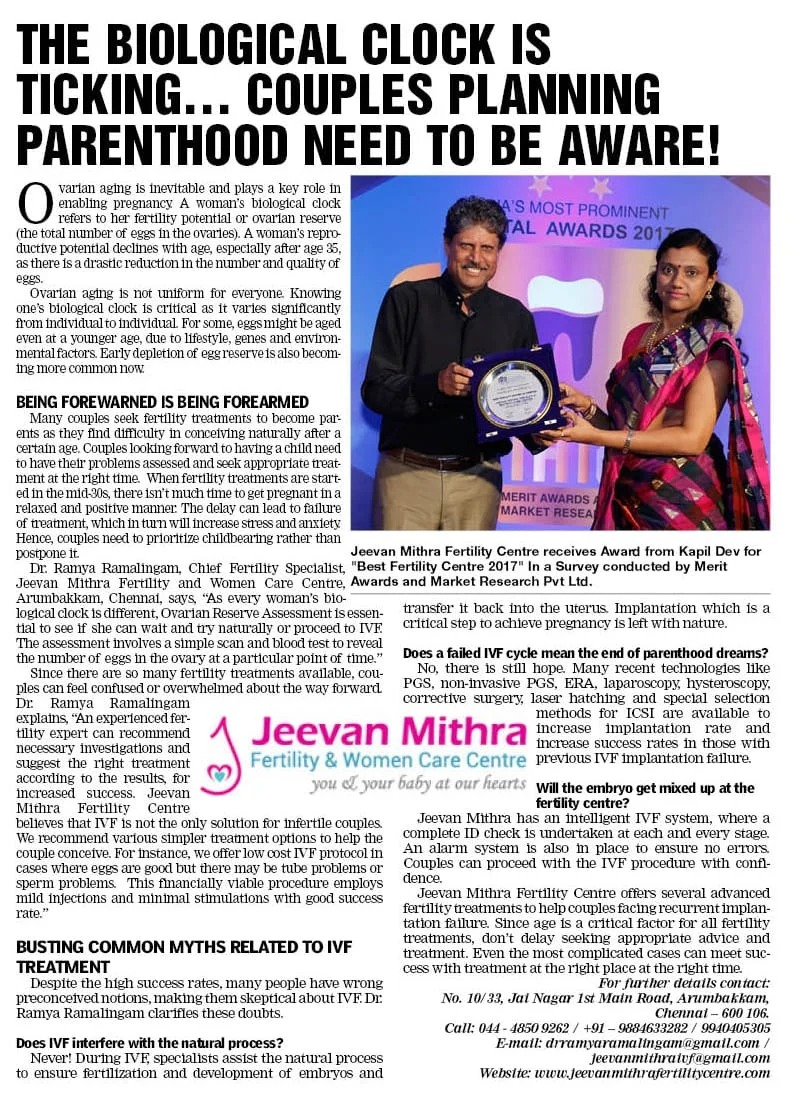
Image caption:
Jeevan Mithra Fertility Centre receives Award from Kapil Dev for “Best Fertility Centre 2017” in a Survey conducted by Merit Awards and Market Research Pvt Ltd.
BUSTING COMMON MYTHS RELATED TO IVF TREATMENT
Despite the high success rates, many people have wrong preconceived notions, making them skeptical about IVF. Dr. Ramya Ramalingam clarifies these doubts.
Does IVF interfere with the natural process?
Never! During IVF, specialists assist the natural process to ensure fertilization and development of embryos and transfer it back into the uterus. Implantation which is a critical step to achieve pregnancy, is left to nature.
Does a failed IVF cycle mean the end of parenthood dreams?
No, there is still hope. Many recent technologies like PGS, non-invasive PGS, ERA, laparoscopy, hysteroscopy, corrective surgery, laser hatching, and special selection methods for ICSI are available to increase the implantation rate and success rates in those with previous IVF implantation failure.
Will the embryo get mixed up at the fertility centre?
Jeevan Mithra has an intelligent IVF system, where a complete ID check is undertaken at each and every stage. An alarm system is also in place to ensure no errors. Couples can proceed with the IVF procedure with confidence.
Jeevan Mithra Fertility Centre offers several advanced fertility treatments to help couples facing recurrent implantation failure. Since age is a critical factor for all fertility treatments, don’t delay seeking appropriate advice and treatment. Even the most complicated cases can meet success with treatment at the right place at the right time.